
What is Sarvam AI’s Token Factory and why is it drawing fire for hosting Chinese model?
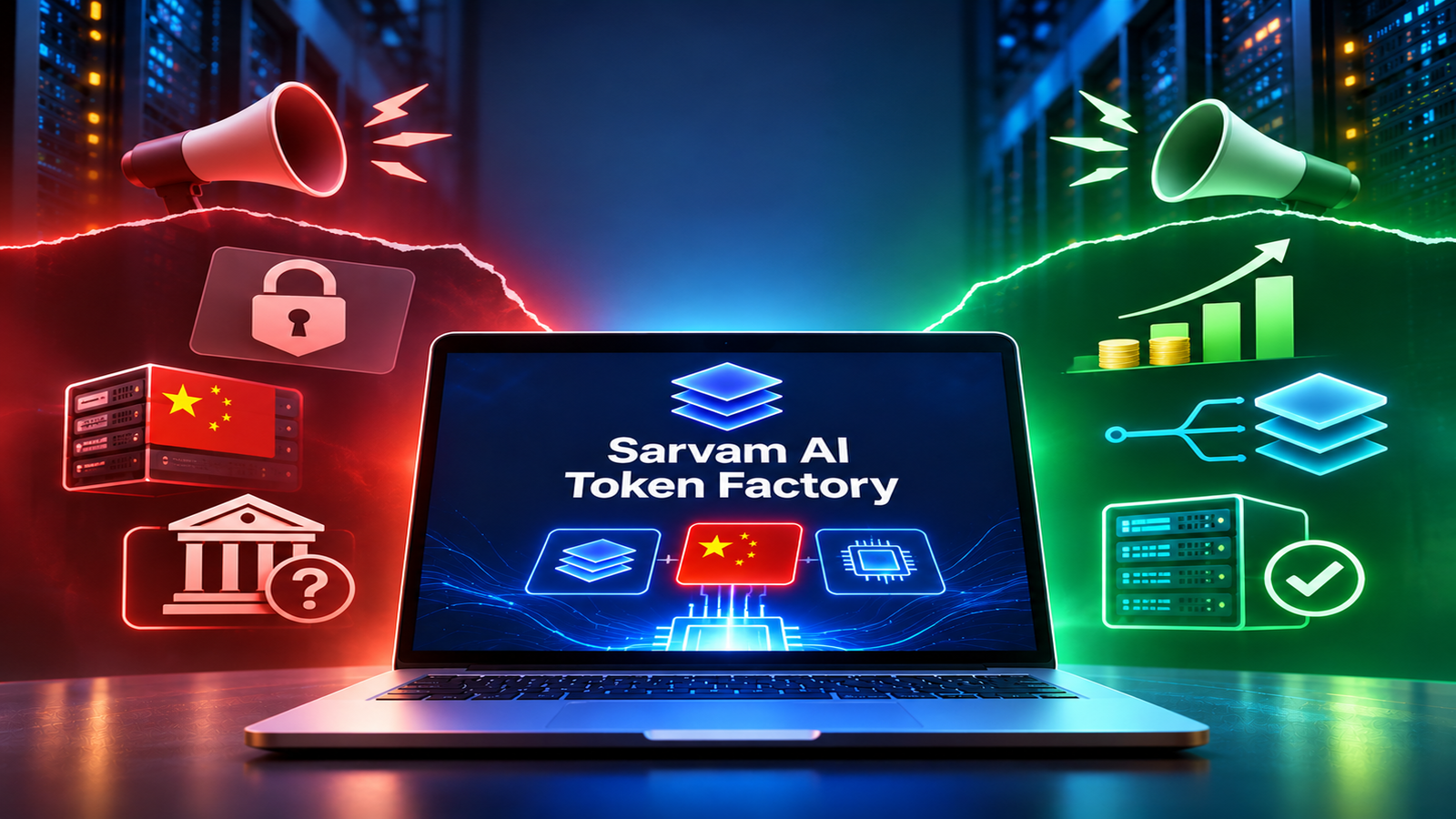
Sarvam AI's Token Factory is essentially an inference stack that allows companies, startups and institutions to build and deploy AI-powered products without having to invest heavily.India’s unicorn AI startup Sarvam AI had launched its Token Factory on Tuesday, a technology platform designed to run both its own AI models and leading open-weight models on GPU infrastructure located in India.However, shortly after the announcement, Sarvam AI faced a wave of criticism from across the AI industry, with several industry observers questioning the launch.
The scale of the backlash has been particularly striking, making it one of the most heavily criticised AI product launches in recent times.
What is Token Factory?Sarvam AI's Token Factory is essentially an inference stack that allows companies, startups and institutions to build and deploy AI-powered products without having to invest heavily in setting up their own computing infrastructure.
Developing an AI product typically requires access to GPUs, computing power, hardware, capital and technical expertise, all of which can be expensive and time-consuming to arrange.
Token Factory brings these capabilities together on a single platform, allowing businesses to access and run different AI models hosted on its infrastructure and use them to develop their own AI applications.
In effect, it reduces the infrastructure and investment burden, enabling companies to focus on building and scaling their AI products rather than setting up the underlying technology.Alongside its flagship Sarvam 105B model, the platform supports GLM 5.3, GLM 5.3 Flash, DeepSeek V4.1 Flash 1017, DeepSeek V4 Pro, Kimi K3.1 Pro and Gemma 4 31B, accessible through a single OpenAI-compatible API, said the company in their blog post.Sarvam says that through Token Factory, it aims to provide computing infrastructure to individuals, startups, application developers and institutions, enabling them to build and deploy AI-powered products using its own models as well as other open-weight models.The sovereignty question Sarvam AI's Token Factory promised lower GPU costs and faster response times, but its decision to host Chinese AI models has been the central point of criticism from sections of the AI community.Shakthi Vadakkepat, who works on optimising token economics and building scalable agentic architectures, questioned the company's approach, arguing that despite government backing and its positioning as a key player in India's indigenous AI development, Sarvam is relying largely on Chinese large language models (LLMs) alongside one of its own models.He also pointed out that several other companies already offer similar services, raising questions about what differentiates Sarvam's offering.
Vadakkepat argued that hosting predominantly Chinese models on Indian infrastructure does little to advance the country's AI sovereignty ambitions and called on the government to reassess its approach to public funding and GPU subsidies, ensuring that taxpayer money supports the development of genuinely indigenous AI capabilities.The criticism also stems from concerns over the data security and reliability of Chinese AI models.
Industry observers have raised questions about data privacy, potential access to sensitive information and the risks enterprises could face when using these models, particularly when handling confidential business or customer data.
Such concerns could undermine trust among Indian companies considering adopting the platform.Supportive voicesAmid the backlash over Sarvam AI's latest product launch, some industry observers have defended the Token Factory, arguing that it is an important step towards advancing the company's long-term vision for India's AI ecosystem.Hemant Mohapatra, partner at Lightspeed India, said global AI companies, including those developing Chinese AI models, are generating significant revenue by running their models on infrastructure in India.
This is driven by a global shortage of GPUs, the powerful chips required to train and run AI models, and the availability of computing infrastructure in India.According to Mohapatra, Sarvam's Token Factory is an attempt to capitalise on this opportunity.
Rather than relying solely on developing and monetising its own AI models, Sarvam can also generate revenue by offering the computing infrastructure and services required by other companies to run their models.Diversifying business operations can be an important driver of growth, and experts argue that Sarvam's move could help it tap into this opportunity.
With India accounting for nearly 20 per cent of global compute consumption, they believe the country should also leverage its domestic computing infrastructure to host and serve Chinese AI models locally.
This could help meet domestic demand while potentially reducing foreign exchange outflows by limiting the need to access computing services hosted overseas.
DISCLAIMER: This content is automatically collected from Enterprise AIfor informational purposes.
To read the original article, please click here
IAI AC | IAIAC.IN| Institute of Artificial Intelligence Applications Centre