
AI’s fear files: How warnings of AI risks are becoming part of the business pitch
The rising cost of developing frontier models is already raising the financial barrier to competing at the cutting edge.
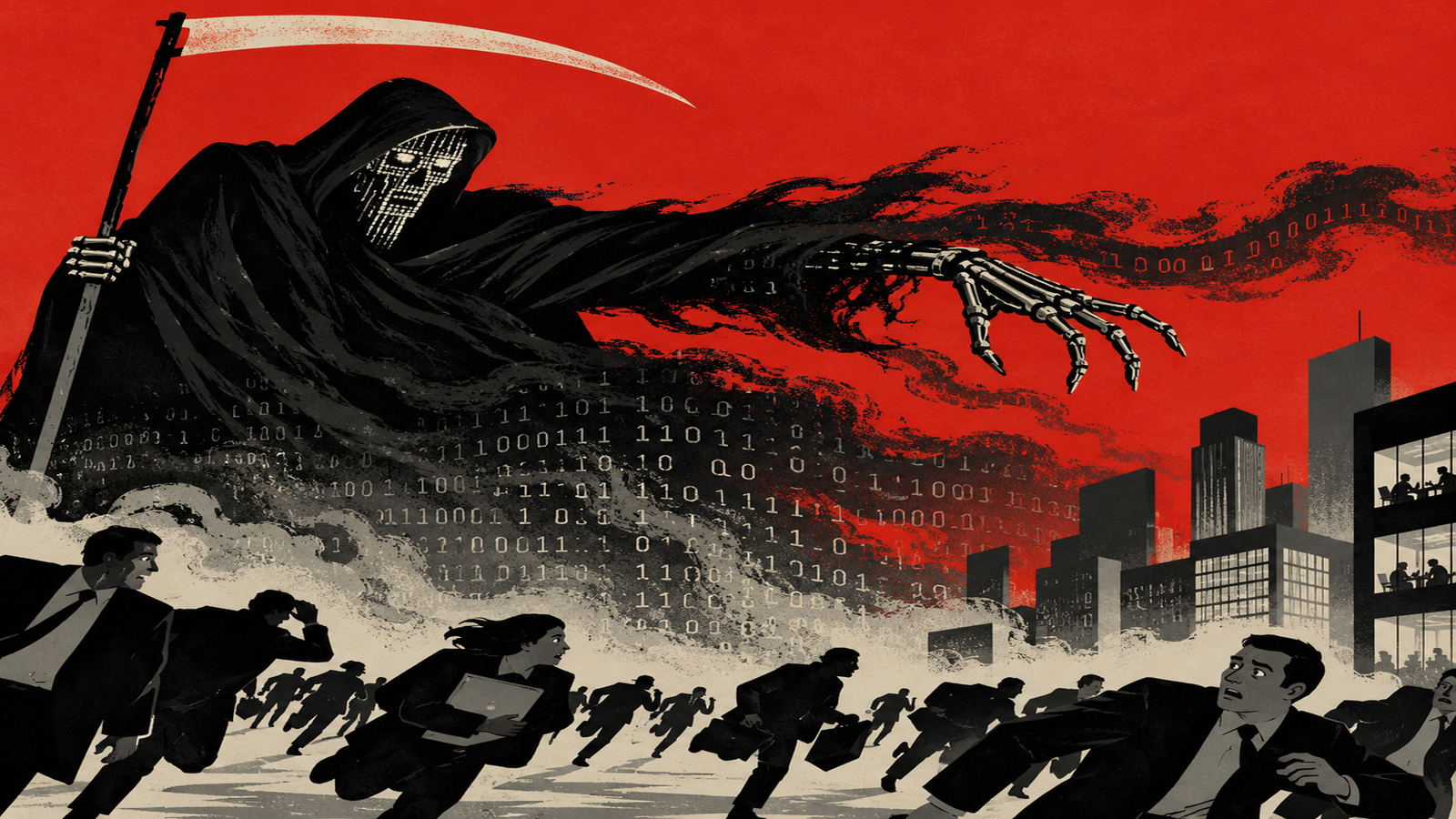
Regulation could add another layer.” When AI tech giants, including Anthropic and OpenAI, recently raised the ‘doomsday alarm’ over the potential capabilities of the technology they command, a lot was said about the risks of AI, the need for safeguards, and the responsibility of those building it.
The alarm followed the resignations of some senior researchers at Anthropic– Jacob Coxon and Joe Benton–who highlighted the existential threat this technology possesses.Yet all the hullabaloo around AI conceals a harder question: When researchers walk out the door citing existential risk, and firms market their own creations as potentially catastrophic, is fear itself becoming a product feature—a differentiator sold to investors and the public alike, rather than a warning meant to be heeded?According to Syed Shahrukh Ahmad, co-founder at CloudSEK, both things can be true at once—but excitement generated by risky claims is bound to garner more attention.“Frontier labs mainly target developers, engineers and IT, so ‘our model writes great code fast’ is no longer enough; framing capability as danger excites both developers and security buyers,” he said.
Whereas Rushabh Shah, managing partner at STIR Advisors puts it this way, if a company demonstrates that its technology can expose weaknesses in critical infrastructure, it can create urgency among customers and investors simultaneously.
When the reporter of this report made a speculation about how the launch of Anthropic’s Mythos was fabricated, to juggle the pockets of investors, to mint more money.As for the first time an AI model was named: “Too dangerous to release.”The maker of ChatGPT, Sam Altman had to make an appearance on a science and technology podcast, Core Memory.
Where he implied that Anthropic is using “fear-based marketing.”The next month after the release of Mythos to a selective group of individuals, the company raised a colossal funding of $65 billion in Series H funding round.Shah, however, challenges that speculation, noting that of the $65 billion in funding, $15 billion was previously committed investment.
That distinction matters when interpreting the timeline.“A funding round announced in May may reflect negotiations and investment decisions made over a longer period,” he said.Since both of the companies, Anthropic and OpenAI are in a race to ace; Anthropic is targeting a valuation between $1 trillion and $2 trillion, with its latest private market valuation around $965 billion.On the other hand OpenAI is aiming for a $1 trillion or higher valuation, though leadership has indicated public timing may slide into 2027.
Although, its recent private market valuations have hovered around $852 billion. “A higher IPO valuation, a larger capital raise, stronger customer adoption and technological leadership are different outcomes,” said Shah, “one company could lead on valuation while another has better economics or a stronger position in government procurement.”For him, the practical advantage of raising more capital is that it can finance compute, research, recruitment and customer acquisition for longer.
A company may also be able to offer more competitive pricing or absorb losses while rivals face financing constraints.If Anthropic emerges as the commercial leader, its approach to controlled access, security evaluation and enterprise deployment could gain greater influence over customer expectations, he added.
Investors, too, might attach more value to those capabilities.But a higher valuation would not itself validate every safety claim, Shah cautioned, nor ensure that the company keeps the same restrictions under competitive pressure.If OpenAI comes out ahead as a commercial leader, its platform and distribution advantages could strengthen, and its approach to government deployment could carry more weight in procurement.
That would be a commercial outcome, he said, "not proof" that its approach is inherently safer or less safe.According to a July report by Financial Times, OpenAI was in early stage talks to give a 5 per cent stake to the US government in the ChatGPT developer.
The talks came as artificial intelligence companies sought to mend relations with Donald Trump’s administration.The high and low notes: Cost and regulatory barriersIn April 2024, Dario Amodei made a nostradamus claim, He said, by 2025-26 we will reach a $5 or $10 billion training bracket for AI models.
Epoch AI, a non-profit–multidisciplinary research institute, made a similar claim in their report launched in the same year.“The most expensive publicly announced model by the start of 2027 will cost about $1 billion” the Epoch AI report said.As the world navigates the turmoil triggered by the rogue AI agent attacks, the incident brought together a triumvirate of AI chiefs, Sam Altman, Dario Amodei and Elon Musk, coming together and calling out for regulation in the development of AI.The rising cost of developing frontier models is already raising the financial barrier to competing at the cutting edge.
Regulation could add another layer.” Well, both, Shah and Ahmad—agreed—it will be easier for large incumbent labs and platforms as well as providers of testing or compliance services to bear the burnt of cost, regulatory approvals and audit over head than new entrants—such as a new startup or open source project developers.“What decides who benefits is threshold design: Obligations targeted at genuine frontier capabilities, lighter requirements for smaller developers and open source, and evaluation through independent, real-world benchmarks rather than standards set by the companies being evaluated,” said Ahmad.
Shah, however, cautioned that benefit alone does not establish intent.“Proportionate requirements, affordable evaluation routes and recognition of equivalent safeguards can improve safety while preserving competition.
Poorly designed rules can do the opposite,” he said.Cybersecurity to add tension to the tuneGrit is a good thing, perhaps the best of the things, but when it is displayed by the agents with artificial intelligence it becomes quite concerning.In fact, Ahmad puts it like this, amongst the competition from each other, when labs are focused on winning a short-term race, long-term planning suffers, and that can create problems beyond the digital world. “We don't know how seriously every frontier team takes security, but recent events show things are picking up pace,” he said.He gives an example of a recent OpenAI–hugging face incident, where OpenAI models bypassed the controls meant to isolate them from the internet and compromised parts of OpenAI's own infrastructure and Hugging Face's systems.Aside from the shortcomings, these models are also a blessing.Ahmad says these models are solving security problems that were unsolvable until now: exploit development, uncovering issues hidden for years, and applying reasoning where static rules fail.
For Shah, there is a huge opportunity which lies further in the cybersecurity sector.
The US leads with 9,910 cybersecurity startups, followed by the United Kingdom with 3,996 and India in third place with 1,875.
The gap, however, widens considerably when it comes to capital.
While India ranks third by number of cybersecurity startups, it slips to ninth in terms of funding raised, at $1.03 billion.
By comparison, cybersecurity startups in the US have raised $111 billion, while those in the UK have raised $5.43 billion.Ahmad points to public markets as another indication of how AI narratives can influence capital. “The clearest evidence that narratives move money is in public markets: cybersecurity stocks sold off sharply after the Mythos announcement, and then CrowdStrike and Palo Alto Networks rose more than 70 per cent each between April and end of May,” he said.
DISCLAIMER: This content is automatically collected from Enterprise AIfor informational purposes.
To read the original article, please click here

IAI AC | IAIAC.IN| Institute of Artificial Intelligence Applications Centre